
Understanding Thomas Jefferson
The Man Who Saw Slavery’s Evil but Couldn’t Imagine Black Equality

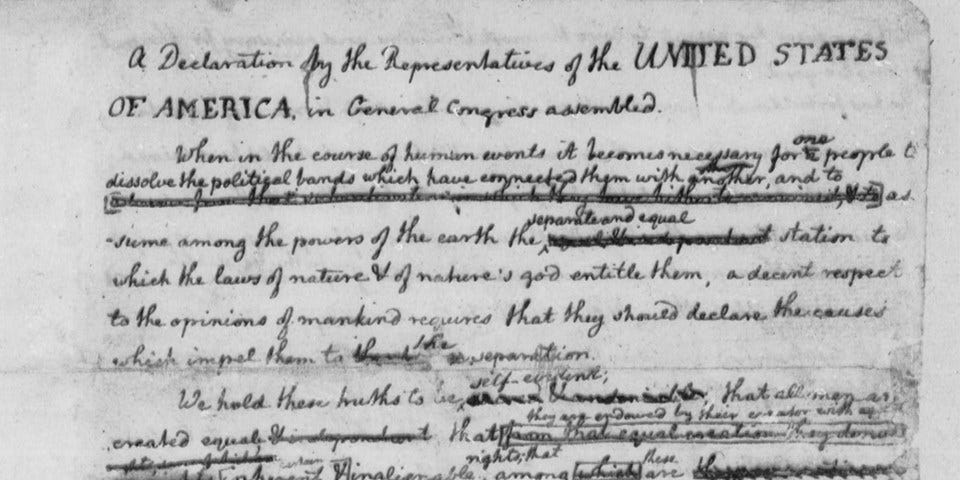
Thomas Jefferson wrote that “all men are created equal” while owning hundreds of enslaved people. He repeatedly called slavery repugnant and looked forward to its abolition, yet he freed only a handful of the men, women, and children he held in bondage—most of them his own children with Sally Hemings. How, then, are we to understand Jefferson? When he declared the equality of men, did he truly mean all men, or only white men? And why did the author of such soaring words against tyranny free almost no one?
Jefferson’s views on slavery were not simple, but they were not as contradictory as they first appear. When he drafted the Declaration, he was drawing on Scottish moral-sense philosophy: the belief that every human being possesses an innate moral sense capable of recognizing self-evident truths. A republic built on those truths would elevate its citizens and bind them to the common good. Crucially, Jefferson did not exclude Black people from this moral capacity. In Notes on the State of Virginia he wrote that he trembled for his country when he reflected that “God is just” and hoped the nation was “preparing under the auspices of heaven for a total emancipation.”
He understood exactly how slavery corrupted both master and enslaved:
“The commerce between master and slave is a perpetual exercise of the most boisterous passions, the most unremitting despotism on the one part, and degrading submissions on the other… With what execration should the statesman be loaded, who, permitting one half the citizens thus to trample on the rights of the other, transforms those into despots, and these into enemies…”
Yet Jefferson also believed—on the basis of what we now recognize as deeply flawed and racist pseudoscience—that Black people were permanently inferior in intellect and imagination. He claimed they had never produced art or abstract thought worthy of notice, that “in reason [they are] much inferior,” that “in imagination they are dull, tasteless, and anomalous,” and even that they secreted less by the kidneys and more by the skin, giving them “a very strong and disagreeable odor.” These alleged natural differences made peaceful coexistence after emancipation, in his view, impossible.
“Deep rooted prejudices entertained by the whites; ten thousand recollections, by the blacks, of the injuries they have sustained; new provocations; the real distinctions which nature has made… will divide us into parties, and produce convulsions which will probably never end but in the extermination of the one or the other race.”
His solution was not integration but removal: freed Black Americans must be sent “beyond the reach of mixture”—to Africa, the Caribbean, or anywhere else—so they could live as a “free and independent people” separate from whites. “If a slave can have a country in this world,” he wrote, “it must be any other in preference to that in which he is born to live and labour for another.”
In practice, Jefferson did far more to strengthen and spread slavery than to end it. The Louisiana Purchase in 1803, negotiated under his presidency, doubled the size of the United States and opened vast new territories to slave-based cotton cultivation. The resulting cotton boom supercharged the domestic slave trade: hundreds of thousands of enslaved people from the Upper South were sold away from their families and marched in coffles to Alabama, Mississippi, Louisiana, and Texas. When Missouri sought admission as a slave state in 1819–1820, Jefferson fiercely opposed any restriction, insisting that “the extension of slavery” was less important than the expansion of the empire of liberty—for white people.
In the end, the man who wrote “all men are created equal” left office having made slavery larger, richer, and more entrenched than he found it. He freed only a tiny number of the human beings he owned—almost all of them his own children by Sally Hemings, the enslaved teenager who was also his late wife’s half-sister.
Jefferson’s tragedy—and America’s—is that a mind capable of imagining universal moral equality could not imagine a nation in which Black and white people lived together as equals.
(Based on Thomas Jefferson’s Notes on the State of Virginia and the lectures of Prof. Stephanie McCurry in her Coursera course History of the Slave South, University of Pennsylvania)