


When we think of large ancient civilizations, the images that come to mind are Pharaohs, Pyramids, and Palaces. Egypt and Mesopotamia were complex societies with a distinct social structure which included rulers, priests, free citizens, goat herders, and slaves. When it comes to Saraswati-Sindhu civilization (SSC), there is no evidence for elaborate tombs or huge monuments. There are no exclusive palaces or temples. At the same time there is evidence of uniformity and technological progress, like standard weights, drainage systems and shared public utilities. Does this mean that SSC was an egalitarian society without rulers or administrators? Is it possible for a complex society to run without a ruling class, where even a local trader had a say in how the city was built?
It has been more than a century since the SSC has been discovered. 100 years of archaeology has not upset the initial assumptions of the egalitarian society. In this article we will look at the governance of the SSC, considering how it managed to thrive without a traditional ruling elite.
Saraswati-Sindhu Civilization

The SSC emerged over a vast territory, surpassing many other early complex societies in geographical scope. Spanning from the Himalayas to the Arabian Sea, it covered diverse climatic regions, including coastal, arid, and mountainous areas. Its expanse exceeded that of both Egypt and Mesopotamia combined. Remarkably, its mature phase endured for a period of 700 years.
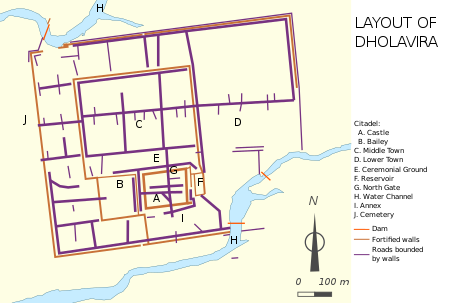
Now we know of many major cities like Mohenjo-daro, Harappa, Ganeriwala, Dholawira, Rakhigarhi, Lothal etc. Besides this there are many smaller settlements with a vast majority along the banks of the Saraswati river. Who could say no to riverfront property? (See Michel Danino’s The Lost River. It was not just large, but had used various technologies like writing, metallurgy, weights and measures and seals. The SSC was characterized by urbanization, specialized production, and the consumption of a wide range of foods.
There were different kinds of structures distributed throughout the site, and houses came in a variety of different types, all of which incorporated courtyards, wells, and specialized domestic activity areas. Some larger houses were even called palaces, suggesting that they were used by different groups of elites. But they were not palaces and were not occupied by a ruling class.
There were other magnificent structures like the great bath. In Egypt and Mesopotamia, all the great conveniences were restricted to palace contexts, but the great bath was made for public use. What is surprising about the SSC is the egalitarianism. People living there had private houses with features known only to kings. They had bathing platforms and drainage. In other civilizations, structures that took huge effort to build were only available to the people who ruled over the population and controlled the resources, but not so in SSC.
The openness of this is very striking. Imagine a slave working on the pyramids at Giza mozying his way to the Pharaoh's palace for a bath. Around the Mediterranean, such facilities were available to people only at the top of the pyramid (Technically, the Pharaoh moved to the bottom of the pyramid after death. Haha).
In the case of SSC, there is evidence of things happening at a large scale which is not controlled by a stratified elite. Scholars have looked for a king, a priest king or a ruler elite for a century and found none. There is no evidence of dynastic tombs, human sacrifice or slavery. This has raised questions about its exceptionality and this questions traditional assumptions about distribution of wealth, hierarchies of power, specialization and urbanism.
Ruling Elite Theory

Why were scholars looking for a ruling elite in the first place?
The ruling elite theory permeated early archaeological thinking about complex societies. A lot of these theories were influenced by Marx, who thought that urban revolution was driven by a ruling class, who exerted control through the state. In fact the core idea is that it is the presence of the ruling class that separates complex urban societies from those that predate them. When there is a ruling class, they can employ specialists in subordinated classes like artisans, soldiers, and bureaucrats to undertake projects dictated by the administration.
It was argued that urbanization was driven by a ruling class which controlled society through the state and redistributed food surpluses. These elites also tapped into long-distance trade networks to bring in prestige goods which showed their dominance. Elaborate tombs, aggrandizing monuments, or large and restricted temples and palaces are the best evidence of a ruling class. The Old Dynasty Egyptian pyramids and retainer sacrifice are evidence of a ruling class. When access to palaces and monumental temples was restricted, it was an indication of a crown and scepter.
According to ruling elite theory, large scale sociological change can happen only with a ruling elite. Ruling elites also bring inequality and warfare. There can’t be cities without stratification. Stratification in turn brings rulers who bring in specialists. Finally you end up with an exclusionary political hierarchy.
The SSC diverges from Marxist theory, challenging the conventional belief in the necessity of a ruling class for the evolution of complex societies. Contrary to this notion, the SSC demonstrates economic growth, technological advancement, and the provision of public amenities without the accompanying trappings of elitism such as opulent palaces, exclusive temples, or elaborate tombs reserved for the elite.
When archaeologists tried to fit the evidence from SSC against the social evolution theories, it did not fit. Then what to do? Try to import some of the Western concepts into India. But trying to fit square pegs into round holes is like watching a snake try to swallow a large frog – painful for everyone involved.
Collective Action 101
There are other alternatives to the ruling elite theory. Collective action is one of them. If you share a fence with your neighbor if it needs repair, you collaborate. If an apartment complex needs to be painted, then the residents collaborate and get the job done. This cooperation has to be imagined at a large scale for efforts that favor a large population. Societies exhibit collective action where there is a joint endeavor between people who share resources.

Societies that work together tend to put their efforts into things that benefit everyone, like building roads and bridges that everyone can use. These societies also often have political systems where different people share the power, like the government in Tlaxcallan, a place in ancient Mesoamerica where they had a republic. This connection between sharing power and working together might help explain why some societies don't have individual rulers, like during the time when Teotihuacan, also in Mesoamerica, was growing bigger and bigger.
The study of such societies reveals that collective action was achieved without a ruling elite. Egalitarian complex societies without a ruling class must organize their collection action without resorting to a fixed and immutable hierarchy. Collective forms of social organization require a rigorous process of consensus building across large cross-sections of society.
The earliest communities in Mesopotamia emerged from these social and economic processes. In such societies, working together is crucial. In societies led by elites, force can be used to make people do things. But in societies where people work together, having fair relationships between everyone is key to keeping cooperation and agreement. This works best in societies where the political and economic systems are fairly equal. Studies comparing different societies suggest that when people can work together well, it affects how society changes over time.
Certain types of working together seem to make it harder for leaders to force people to do things or gather wealth only for themselves. Instead, these societies create things like roads and buildings that help everyone. Keeping fair relationships between people might be a good way to keep everyone agreeing and working together, which can lead to more collaboration over time.
Evidence from SSC
At SSC, signs of people working together and organizing themselves politically can be seen in big public buildings, how settlements were planned, and in the way craft goods were made. Take the Great Bath in Mohenjo-daro, for example. It's a huge structure that needs lots of people from different groups to work together. In Harappa's Mound F, there were also big buildings, showing that many people put in a lot of work. At Dholavira, the highest part of the site is behind a strong wall with a well-made entrance. Behind it are deep reservoirs dug into the rock. The buildings in the SSC were famously built along streets and lanes, which were planned out carefully. This shows that there was a plan for the whole city, not just one neighborhood. It's clear from standardized weights and seals that lots of different groups of people worked together to make these technologies in SSC.
Communities established rules for farming methods and the weights used for trading. We also find evidence of guilds that set standards for how crafts were made and distributed. In Mohenjo-daro, there's a large hall with pillars where many people might have gathered to talk about important matters. We have proof of these meeting spaces and of other places where decisions were organized and put into action. Throughout the city, there are many small public buildings that anyone can use. These aren't homes but places where locals could meet to discuss things like how streets should be laid out, when to plant crops, or how to make crafts.
Creating specific places for trading, talking, and working together between different groups might have been a way to manage collective efforts without favoring one group too much. By building these special spaces, it could have prevented any one group in Mohenjo-daro from becoming too rich while others suffered.
Seals have been discovered in almost every building at Mohenjo-daro and served various purposes, such as making clay impressions over doorways or on the openings of containers. They were also utilized to seal different types of storage units and containers, indicating their involvement in a broad spectrum of economic activities. Despite their standardized appearance, these seals were made by various groups of artisans, suggesting that production was shared among different communities, all following similar stylistic and technological methods.
Seals in the Saraswati-Sindhu civilization were not limited to traders or elites but were mostly found in ordinary households outside major districts. Thus, the notion that they were solely for marking merchandise by traders is flawed. These tools were widely accessible and used by different societal segments, suggesting non-hierarchical interactions among specialists like guilds. Furthermore, standardized weights were widespread across the region, indicating centralized authority overseeing their use.

The SSC participated in long-distance trade, with artifacts found in excavations across Arabia, Iran, and Mesopotamia. There's no evidence of specific SSC groups being left out of using materials from this trade. Materials favored for SSC crafts, like carnelian and steatite, are widely found in most SSC settlements, often in large amounts. Craft activities and their products didn't seem to be confined to specific areas within sites.
The scattered craft debris found across various locations within sites indicates the involvement of multiple corporate groups in production. Craftspeople collaborated and exchanged knowledge, working side by side. Craft activity areas were structured based on the techniques used, potentially bringing artisans of different crafts into close proximity, encouraging the exchange of ideas and technological advancements.
The collective action theory isn't widely accepted. Many believe the SSC was governed by a strong but elusive ruling class. Some argue it was a potent, class-stratified empire originating in South Asia, possibly projecting military force beyond its borders. Alternatively, proponents of a more modern imperial model propose that SSC's collective action was orchestrated by a centralized state. However, neither perspective fully explains the inclusive and decentralized distribution of wealth and power in the SSC region. Some suggest the absence of evidence of inequality actually supports the existence of a powerful ruling class, capable of suppressing visible signs of social divisions. Yet, the exact locus of this purported coercive imperial authority remains elusive.
Collective action within the SSC probably stemmed from the necessity to construct neighborhood platforms or walls, drawing on labor from various corporate groups, with limited coercion or exclusionary politics. The consistent use of standardized weights and measures throughout the vast expanse of the SSC likely required the agreement of multiple corporate groups over generations. The spontaneous emergence of collective action in the SSC context might elucidate the development of identities that transcend local social divisions. These corporate groups were instrumental in propelling the urbanization process, which necessitated the creation of numerous shared public amenities.
The absence of a ruling class in the SSC society doesn't automatically mean there were no other forms of inequality. It's plausible that distinctions based on age, material culture, gender, and burial practices existed, along with potential social hierarchies linked to urban infrastructure. However, these disparities didn't necessarily translate into a ruling class.
Not a new concept
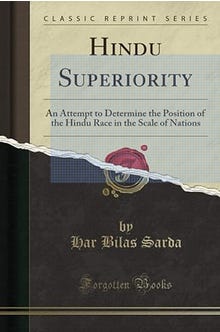
In his book, Hindu Superiority, Har Bilas Sarda, writes, "The form of government depends upon the character of a people, the conditions of life obtaining among them, and the principles of their social system." He writes that the best form of government is one where people are least governed. For that to happen, society has to lay importance to ethical and altruistic principles. The higher the ethical development of character, the greater the freedom enjoyed by a people.
Sarda, writing in 1922, says, "In ancient India, owing to the high ethical and spiritual development of the people, they were not over-governed. They enjoyed the greatest individual freedom compatible with national cohesion and national security. It is owing to this lack of ethical and altruistic development of character among Westerners that freedom, in its true sense, is not yet enjoyed in Europe and America."
References
Green, A.S. Killing the Priest-King: Addressing Egalitarianism in the Indus Civilization. J Archaeol Res 29, 153–202 (2021). https://doi.org/10.1007/s10814-020-09147-9
The Lost River, Michel Danino
Hindu Superiority, Har Bilas Sarda